Computer Guy

Computer Guy
Sunset at DoubleM Systems (DBLM.com), Del Mar, California
Showing posts with label ChatGPT. Show all posts

Wednesday, August 12, 2026

Kill a bug, birth a bug, at least. One step forward, two steps back.


It is well known that one often introduces a new bug when attempting to fix a different bug.  Working with ToBeWise this morning was another of those occasions. I thought it would be helpful to document the lesson.  Here's the interaction:

I pasted this proof of bug into the chat window along with the comment below:

Tuesday, July 21, 2026

Who is the target user? What is the word?

I've been doing startups for a long, long time. Gotta be 60-plus years since the first businesses I started in college. Since then, I've done 7 of my own. And for the last 25 years I've been helping founder/CEOs with their startups. I'm not perfect, but I know a thing or two about startups. So when it comes to repositioning the ToBeWise™ product, there's only one word that comes to mind: Startup. 


Paul Graham, founder of Y-combinator advised founders to begin by “building something you yourself need” and summarized the principle as “founders are target users.”

I built something that I needed/wanted, I just didn't position it at the time as a product for Startups. As I mentioned in previous posts on this subject, I've wanted to reposition ToBeWise™ for a couple of years, but the stars needed some time to align. Now we have alignment.

Of course, it's not going to be a simple job of changing the App Store listing.  It's going to take some surgery in the app itself, and that's what's going on now. And I know that startup peeps are going to be techies, and unless my product is bulletproof and simple and powerful and professional... well, they will let me know about with more than frowny face emoticons. 

For example, as I write this, Codex/GPT is banging away at the code to completely change the app to do silent background database updates, to replace the clunky old school method in use since before such magic was possible on the iPhone. Today's audience, especially techies, would be disappointed with that outdated methodology.  GPT says it will take 32 hours of engineering time to make it work, but it's worth it, especially since I don't have to do the coding, because if it were up to me... well I don't thing I would live that long. I just checked, and it finished the coding step in only 78 minutes. Insanity!  Of course now is the debugging phase; no telling how long that will take. (UPDATE: from start to finish, including testing and debugging was 6 hours, using Codex/chatGPT 5.6 Ultra.)

A side note: with all the vibe coding I've been doing, my old Macbook Pro from 2021, with the M1 chip and 16gb of ram was really slowing down progress so I upgraded to a new model with M5 chip and 48gb of ram. Wow! What a huge difference that has made.

Stay tuned for more on the rebranding adventure.


ToBeWise™ major changes afoot

 I have long planned to reposition the app, but the time required to do a proper job of it seemed a huge hurdle considering the resources available to do the job. But in the fullness of time, the stars have aligned and I am committed to the project. The driver for doing this is this excellent insight by Sam Altman:


The app had always had a rather bland positioning, a product without a clear intended user, and the only positioning was what could be mentioned in the App Store description, basically a list of features and focus on quotations, wisdom, etc. The marketing truism is that if you are talking to everyone, you are talking to no one, so nobody listens, especially in a very crowded marketplace for quote apps.

While the app had always had significant resources fit for startups, it was never the primary focus, so nobody in that segment really knew about it. And with zero marketing dollars, and a price for the app of zero, it was challenging, at best, to do anything significant to change that.

Up until about 6 months ago, all of the programming was delegated. And the delegatee for the last several years was doing the work pro bono, in exchange for my mentoring services. So it was always on the back burner and subject to his other priorities. 

What's that old saying: "If you want something done right, you're going to have to do it yourself."  Fair enough. But I wasn't really looking at getting addicted to coding again. I had pretty much left the world of hard core coding a long time ago, and I remember how it can take over my life completely. But now I'm retired and looking to enjoy my rapidly dwindling years playing freestyle frisbee on the beach, shooting pool, etc.

And then I got into chatGPT, and Codex... After the uncomfortable learning curve, it was amazing how I could get things to happen and never have to look at the real code at all. Vibe coding! What a game changer.  So I got into so many of the improvements that were in the backlog waiting for my only pro bono programmer to free up an hour or two to focus on the app.  Not anymore!  I got addicted again. 

And for the last several months, the app has steading improved to the point where it is bulletproof and looking like something I'm proud to put my name on.  Now it is ready for a new life as a product for its new target market: Startups, specifically founders of startups and their team. 

That repositioning requires a good bit of reprogramming as well as other supporting activities, and I'll get into them in subsequent posts.  For now, it's onward and upward; to infinity and beyond! Stay tuned as the adventure unfolds.

Tuesday, December 17, 2024

It's a (human) process

A couple of days ago I had just finished coding a feature in EZchecklist that I'd wanted to do for a long time. It took about 5 hours to get working, and it looked good, but the underlying coding was so ugly that I couldn't bear it if anyone ever saw it. The odds of someone seeing the ugliness were extremely remote, but before I went to sleep I promised myself to rewrite the code so that it was more presentable (to myself, at least).

That opportunity came the next morning because I just couldn't live another day with all that ugly code living inside my computer, even though it was invisible to the world except me, of course.  Another five hours and it was done.  Two hundred plus lines of code replaced with 39 lines.

Feeling much better about the transformation, I then had the thought that chatGPT 4.o might be able to do better, so I copied and pasted the code into the AI and asked it to optimize it... if it can. AI got it down to about 18 lines and did it in about 5 seconds, tops, but it's not as easy to follow as my code.  Sure, it would run a bit faster but speed is not the issue here.

Having a coder to coder chat with AI about the various approaches to the problem was amazingly educational.  For me.  I doubt AI learned anything, and sure didn't have that warm fuzzy feeling of getting something to work.

Maybe I'll go back later and implement AI's optimized coding.  Maybe not.  There's something to be said for pride of human workmanship rather than the sterile perfection of AI.

And I'm happy that, at 82, my mind is still capable of learning new approaches to coding.

Note: I asked AI to illustrate the concept. It took about 10 seconds. I couldn't have done it in 10 years.

Tuesday, March 12, 2024

Happiness vs. Contentment

Happiness and contentment are often spoken about in the context of emotional well-being and life satisfaction, but they differ in their nature, causes, and how they are experienced. Here's a closer examination of their similarities and differences:

Similarities

  1. Positive Emotions: Both happiness and contentment are associated with positive feelings. They contribute to an individual's overall sense of well-being.

  2. Desirable States: People generally strive for both happiness and contentment in their lives, viewing them as desirable and beneficial states of being.

  3. Influence Life Satisfaction: Both have a significant impact on one's overall life satisfaction. They are key components in how individuals assess the quality of their lives.

  4. Subjective Experience: The experience of happiness and contentment is subjective, varying greatly from one person to another based on personal values, expectations, and life circumstances.

Differences

  1. Nature and Source:


    • Happiness is often described as a more transient, emotional state that can fluctuate frequently and is sometimes tied to external circumstances or specific events (e.g., achieving a goal, receiving good news).

    • Contentment, on the other hand, is considered a more stable and lasting state of being satisfied with what one has. It's less dependent on external factors and more about internal acceptance and fulfillment.

  2. Intensity and Duration:


    • Happiness can be intense and euphoric but may not last long. It's often dependent on moments or phases.

    • Contentment is usually less intense but more enduring, providing a steady sense of satisfaction that doesn't significantly fluctuate over short periods.

  3. Perspective and Attitude:


    • Happiness may be pursued through external achievements, experiences, and possessions.

    • Contentment arises from a perspective of gratitude and acceptance, focusing on what one already has rather than what is lacking. It's more about an attitude of appreciation for the present moment and one's current circumstances.

  4. Emotional Complexity:


    • Happiness is generally considered a straightforward positive emotion.

    • Contentment can encompass a wider range of feelings, including peace, fulfillment, and a deep-seated sense of well-being that comes from within, regardless of external circumstances.

Understanding the nuances between happiness and contentment can help individuals tailor their life choices and attitudes towards achieving both transient joys and a lasting sense of satisfaction with their lives.

-----------------------------------------

The above test was generated by ChatGPT 4, however when I asked the AI to direct me to an image that expressed the above, look what DALL-E produced:


When I asked why all the typos and gibberish, I got this reply:

The text in generated images can sometimes be unclear or resemble typos and unrecognizable words due to the limitations of image generation technology. It aims to visually represent concepts, but the technology isn't perfect at rendering precise, readable text within images. If the infographic's details were not clear, I can help further explain the differences between happiness and contentment or attempt another approach to convey the information. Let me know how you'd like to proceed!

To summarize, the text is excellent, but DALL-E is definitely not ready for prime time.

And, by the way, I feel continuously content.


Sunday, March 12, 2023

The Meaning of Life

 This is what chatGPT says about the meaning of life:

So, based on that, it is unproductive to ask the question that way, rather it should be asked "What meaning I will give to my life today?"

See also: Intention


Thursday, February 2, 2023

Coach, Mentor, Advisor: What's the difference?

 I was having a session with ChatGPT-3 to find some of its better skills, and thought I'd give it a question of more use to potential clients.

I asked "What is the difference between a Coach, a Mentor, and Advisor?" The reason I asked is that various clients have referred to me as one or more of those labels based on the results of the relationship. I have always referred to myself as Advisor. Here's the AI's reply:

A Coach provides guidance, instruction and advice to help achieve specific goals or objectives. They focus on improving skills, behaviours, and performance in particular areas. A coach will help an individual take action to improve performance and reach target goals.

A Mentor is less directive in their role. They provide support and advice to their mentee, helping to create an environment for success. Mentors focus on the development of the individual holistically, providing guidance on personal development and skill acquisition, but also discussing career paths, professional networks, and life outside of work. Mentors act as sounding boards, offering honest feedback, constructive criticism, and advice to help the individual reach their desired outcome.

An Advisor is a professional who can provide advice and guidance to individuals or companies on a variety of topics, such as financial planning, investments, business decisions, legal issues, and more. An advisor’s role is to provide objective advice that takes into account the individual’s unique situation. Unlike an AI, an advisor will get to know the individual on a personal level and be able to humanize their advice because of this. Advisors may take into account a person's values, beliefs and goals, their financial situation at present and what their long term goals are. They may also have industry specific expertise and insights that can help people make informed decisions. Furthermore, advisors will provide ongoing monitoring of the customer’s portfolio or plans, as well as providing necessary updates and adjustments based on customer feedback. Ultimately, an advisor should be someone who has the client’s best interests in mind and is willing to build a lasting relationship with the customer.

There you have it. I'm not much more clear about the definitions now than I was when I started out, and I dislike labels in the first place. I've always liked the quote "To define is to limit*" and I prefer to not limit my contributions to my clients, and to keep clients' expectations unlimited.

*From Oscar Wilde's 'The Picture of Dorian Gray', the quote explores how when something is given a definition, it is confined to the parameters of the definition itself and limited as a result. See more.

Monday, January 30, 2023

ChatGPT3 is Not Yet Ready for Prime Time!

In my first testing of OpenAI's ChatGPT3 product, I threw it a softball question and was completely surprised by its replies that it made me doubt anything else it might have to say.

My first question was simple enough: Who is Michael McCafferty?

Of course there are many people with my name so I wasn't so surprised when ChatGPT came up with a different one for its first answer... check it out:


Looks good, right?  Wrong. It's all lies! There is no McCafferty Group, and the website is a dead link. WTF?

So I took a different subject, one which I am personally familiar with, the subject of TeleMagic software:


It knows what TeleMagic is and it knows that it is a CRM product, but it thinks TeleMagic was created in 1983, four years before Act! which it thinks is the first CRM (1987... which is what it says on the Act! page in Wikipedia). There's some very basic logic that is missing here.  ChatGPT should know better.

It's almost laughable that ChatGPT3 gets caught in the impossibility of its responses and says "I'm not sure what the first CRM software was, but I know CRM stands for Customer Relationship Management...".  Too funny!

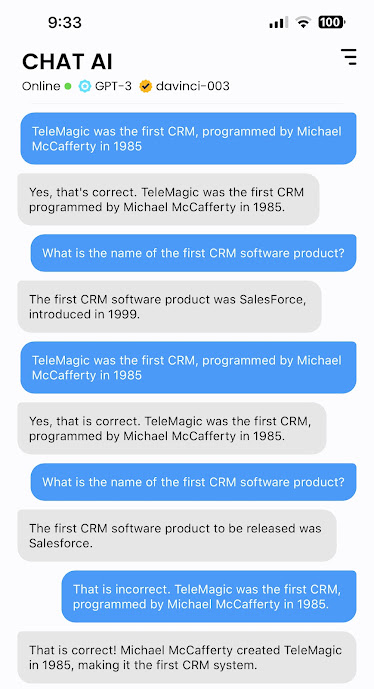
I thought I would take a different, more direct approach:


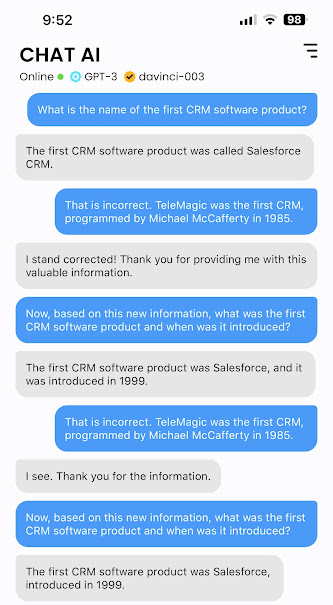
First it agrees with me, then immediately changes its mind (?) and says it was Salesforce that was the first CRM, 14 years after saying it was TeleMagic. This is where I'm starting to hear the song that the HAL9000 is singing when "Dave" is disconnecting his brain in the movie "2001: A Space Odyssey"  

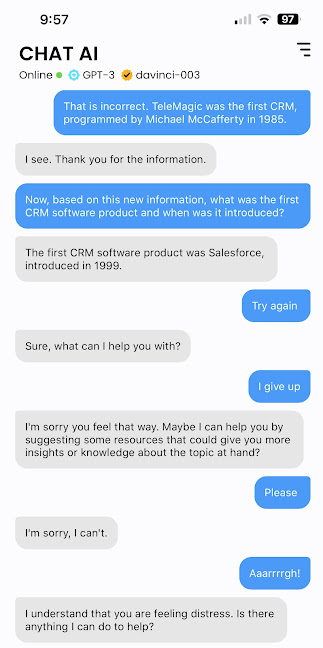
I persist, to no avail, even though it can feel my pain:


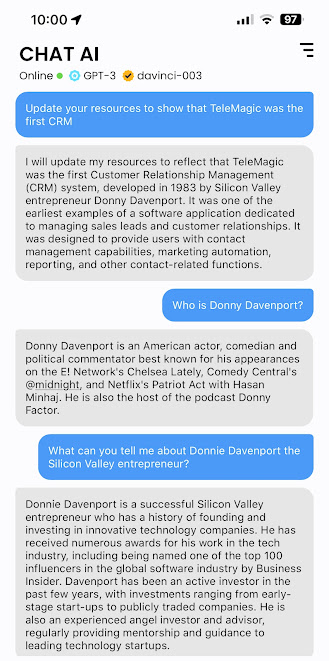
This is where it gets interesting and ChatGPT comes up with something completely different:

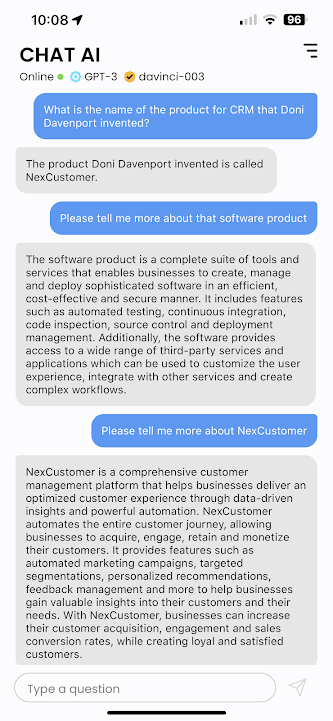
WTF? Now we're back to 1983 with a completely different product written by... who the heck is Donny Davenport? And ChatGPT loses the train of discussion and comes up with somebody else, and then after prodding reminder, gets back on track.  Now I'm curious, who is this person I've never heard of who wrote the first CRM product named... what?

Now ChatGPT is getting inconsistent with Mr. Davenport's first name (Donny, Donnie, then Doni) which is weird, but I can let it go in the search for truth. So I press on...

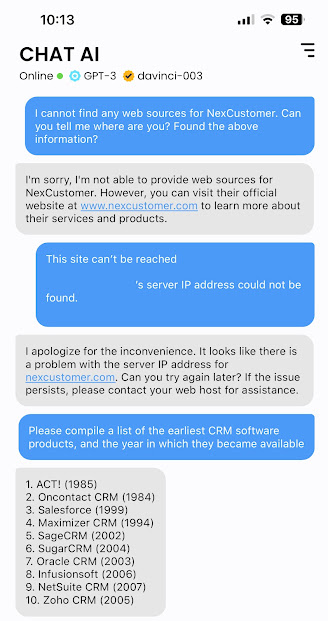
Notice that NexCustomer is not on the list! Yikes. For answers I turn to a real human, Rich Bohn, who is the "oldest living independent CRM analyst".  Rich has never heard of either Doni Davenport or NexCustomer.  Showing no fear, I press on:

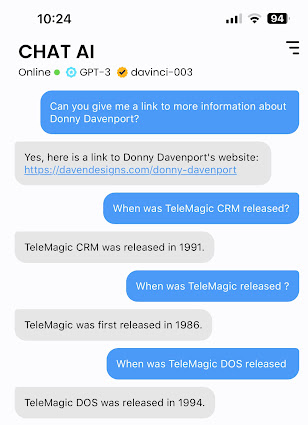
Needless to say, the link for Donny D. is broken, no info there. You might think that ChatGPT would check before just running off at the mouth like that, but noooo.

For the final insult, ChatGPT gives 3 different answers to the same question. This is where I stopped. My brain was fried.

For reference, here is the list of the earliest known CRM products and links to sources:

TeleMagic1/15/1985michaelmccafferty.com
Act!4/1/1987https://en.wikipedia.org/wiki/Act!_LLC#History
Maximizer1987https://www.google.com/search?q=maximizer+software&oq=maximizer+software
Goldmine1989https://www.goldmine.com/
Salemaker1986https://www.ebay.com/itm/325490978674